Chapter 6 - Non-blocking timer runtime
Final task - let's add an asynchronous sleep function that makes efficient use of the runtime.
A (not so) trivial async sleep function could work like so:
#![allow(unused)]
fn main() {
async fn sleep(dur: Duration) {
    let deadline = Instant::now() + dur;
    std::future::poll_fn(|cx| {
        let now = Instant::now();

        // check if our deadline has expired
        if deadline <= now {
            return Poll::Ready(());
        }

        // spawn a thread to sleep
        // then to wake up the task later
        let waker = cx.waker().clone();
        std::thread::spawn(move || {
            std::thread::sleep(deadline - now)
            waker.wake()
        });

        // we are waiting
        Poll::Pending
    }).await
}
}
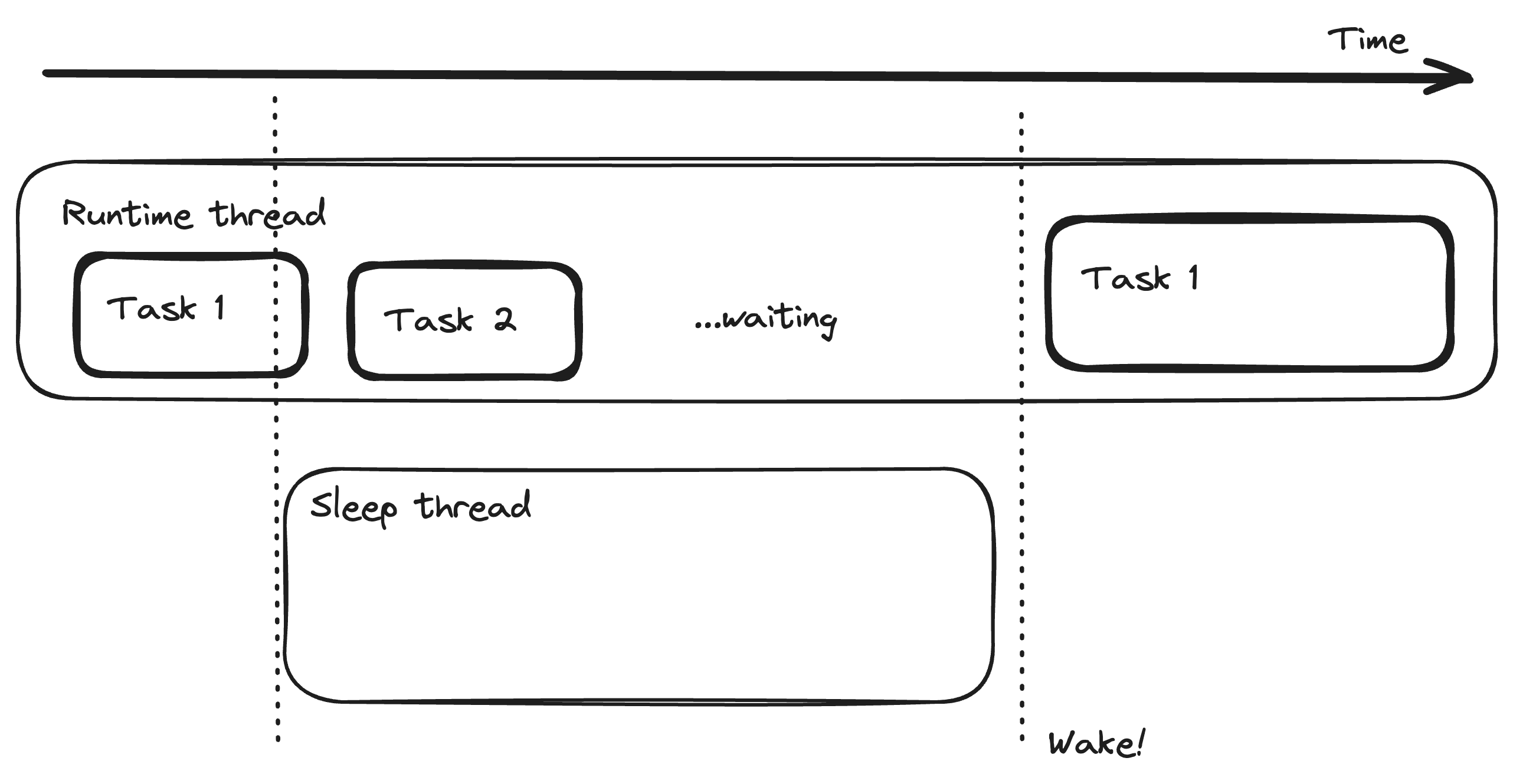
However, can we avoid spawning a thread per sleeping task? Maybe we could fold it into thread parking functionality as well.
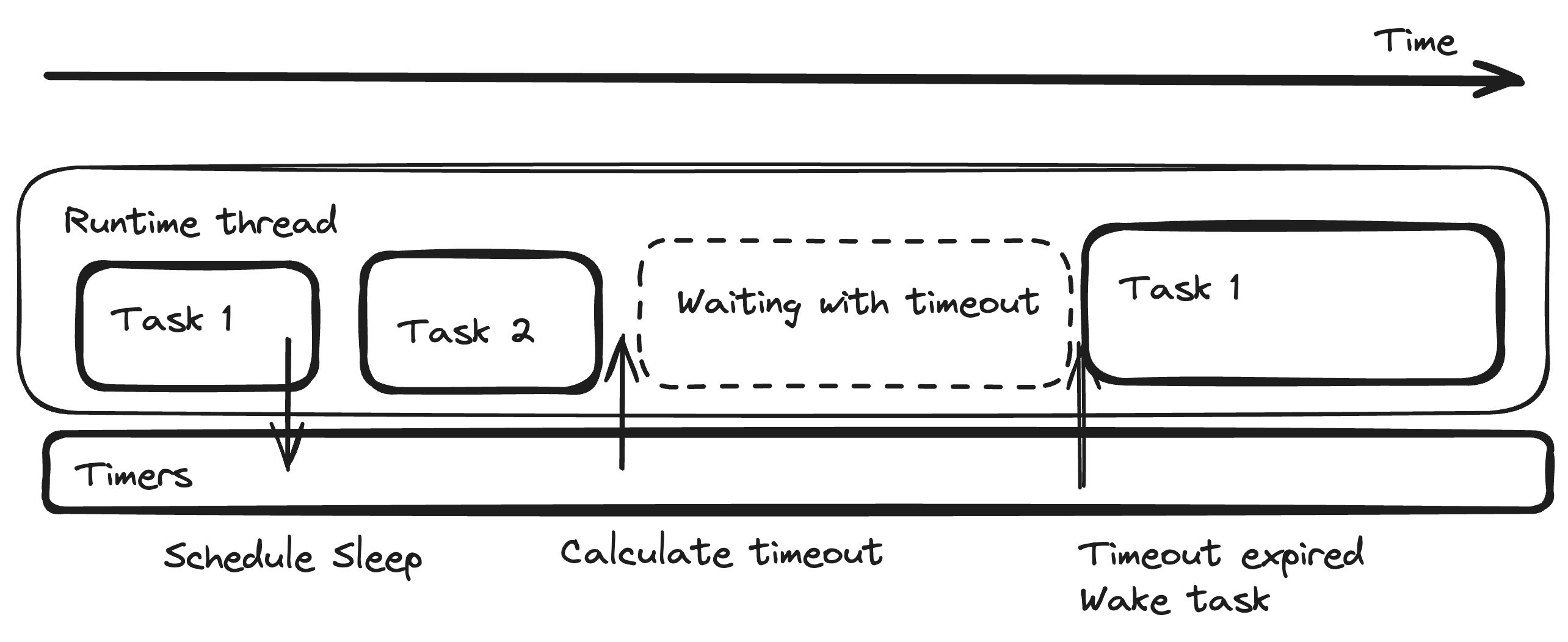
In the previous tasks, we used Condvar::wait to park the thread while idle. Conveniently, there's also
Condvar::wait_timeout which allows us to specify a timeout to immediatly exit on. If we know how long until the next task
might wake up, we can calculate such a timeout and pass it to the condvar.
We just need a way to efficiently keep track of all the tasks that might need to wake up. For that, we could
use a min-heap. Rust's standard library offers a max-heap in the form of the BinaryHeap struct. It has efficient
random insert, and efficient pop which takes only the maximum value from the heap. With some Ord boilerplate, we can
smuggle a task waker and turn our max-heap into a min-heap over the deadline Instant.
#![allow(unused)]
fn main() {
// timers: BinaryHeap<TimerEntry>

struct TimerEntry {
    deadline: Instant,
    waker: Waker,
}

impl PartialEq for TimerEntry {
    fn eq(&self, other: &Self) -> bool {
        self.deadline == other.deadline
    }
}

impl Eq for TimerEntry {}

impl PartialOrd for TimerEntry {
    fn partial_cmp(&self, other: &Self) -> Option<std::cmp::Ordering> {
        Some(self.cmp(other))
    }
}

impl Ord for TimerEntry {
    fn cmp(&self, other: &Self) -> std::cmp::Ordering {
        // BinaryHeap works as a max-heap.
        // We want a min-heap based on deadline, so we should reverse the order.
        self.deadline.cmp(&other.deadline).reverse()
    }
}
}
Now it's your turn to piece this all together